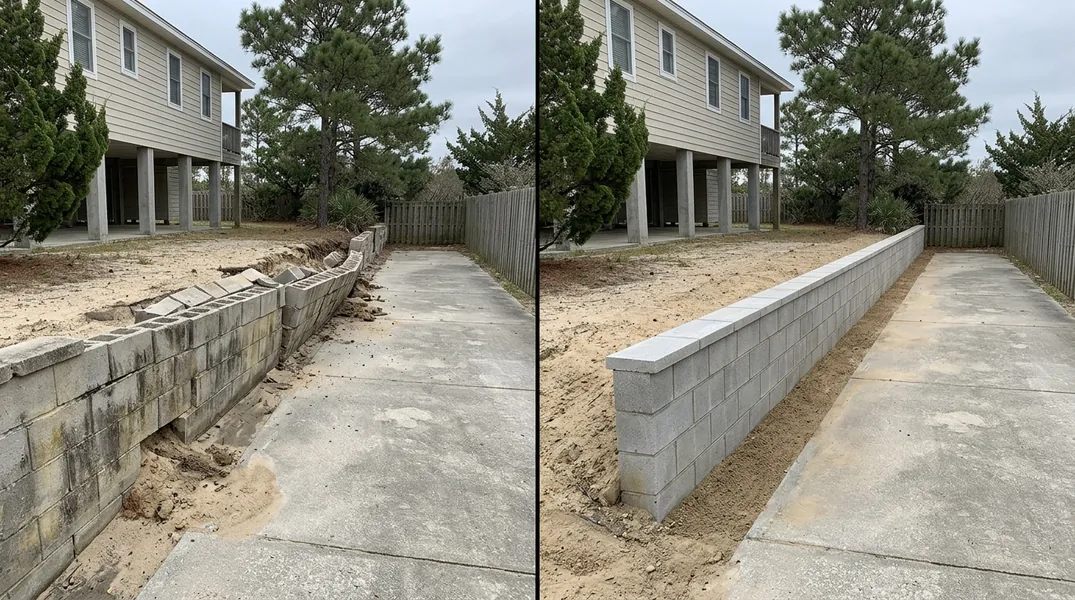
Why Norfolk's Soil and Water Are Tough on Retaining Walls
If you live in Norfolk, you already know that water is a constant presence. Between the proximity to the Chesapeake Bay, the Elizabeth River, and the generally low elevation, many properties sit on soil that stays damp for much of the year. That moisture is the single biggest enemy of a retaining wall. When soil becomes saturated, it expands and becomes far heavier than dry soil. A wall that was designed for normal drainage suddenly finds itself holding back thousands of extra pounds of waterlogged earth, and that pressure has to go somewhere.
Compounding the issue, much of Norfolk's soil includes clay and silt, which drain slowly. Instead of water passing through and away from the wall, it lingers, creating hydrostatic pressure behind the structure. Over time, this pressure pushes against the wall from behind, leading to the classic leaning retaining wall or bowing retaining wall you may have noticed in your neighborhood. Without proper drainage and engineering, even a well-built wall can start to fail within a few years on these low, wet lots.
The Most Common Reasons Retaining Walls Fail in Norfolk
When we inspect a failing retaining wall in Norfolk, we typically find one or more of a few root causes. The first is inadequate drainage. Many older walls were built with no weep holes, no gravel backfill, and no French drain behind them. Water builds up, and the wall eventually cracks or tilts. The second is poor foundation preparation. On soft, wet ground, a wall needs a properly compacted base and often a concrete footing. Skipping this step leads to settlement and movement. The third is underestimating the load. A wall that is too short, too thin, or built with the wrong materials for the height of soil it holds will fail under pressure.
Another frequent culprit is tree roots and vegetation. Roots can invade the backfill, disrupt drainage, and physically push against the wall. Finally, age and lack of maintenance take a toll. Small cracks let in water, which freezes and expands in winter, widening the cracks. If you are seeing any of these issues, it may be time to consider Retaining Wall Repair before the problem gets worse. In severe cases, a full Retaining Wall Replacement may be the more cost-effective long-term solution.
Warning Signs: How to Spot a Failing Retaining Wall
Not every wall problem is obvious at first glance, but there are clear warning signs you can check yourself. Look for any visible lean or tilt, especially if the top of the wall is moving away from the soil it holds. A bowing retaining wall that curves outward is under significant pressure and needs attention. Check for cracks, particularly horizontal cracks or stair-step cracks in block walls. These often indicate movement in the foundation. Also look for soil settling or sinking behind the wall, which can signal that backfill is washing away. If you see water pooling at the base of the wall or muddy streaks on the face, drainage is failing.
Other signs include bulging sections, loose or missing blocks, and gates or fences attached to the wall that no longer close properly. In more advanced cases, you may notice the wall pulling away from adjacent structures or the ground around it eroding. Any of these symptoms suggest you should have a professional take a look. A leaning retaining wall is not something to ignore, because the cost of repair rises quickly once a wall actually collapses. If you are unsure, a free estimate from a qualified contractor can give you peace of mind.
Retaining Wall Repair Near Me: When to Call a Professional
If you are searching for retaining wall repair near me in Norfolk, you are probably already seeing some of the warning signs described above. The question is whether the issue is cosmetic or structural. Small surface cracks and minor settling can sometimes be addressed with targeted repairs, but anything involving leaning, bowing, or significant movement usually requires a professional assessment. A contractor can evaluate the drainage, the foundation, and the load to determine whether repair or replacement makes more sense. Trying to patch a failing wall yourself often just delays the inevitable and can make the eventual repair more expensive.
Professional repair might involve installing proper drainage, reinforcing the wall, or rebuilding sections. For walls that are beyond saving, replacement with a more suitable system, such as Concrete Retaining Walls, can provide a durable solution that handles Norfolk's wet conditions. Concrete walls are often better suited to these low, wet lots because they resist moisture damage and can be engineered for the specific loads. If you are in Virginia Beach, Chesapeake, or Portsmouth, the same soil and water challenges apply, so it is worth having a professional take a look regardless of where you are in the region.
How to Prevent Retaining Wall Failure on Your Norfolk Property
Prevention starts with proper design and installation. If you are planning a new wall, make sure it is engineered for the soil conditions and drainage needs of your specific lot. That means a proper base, adequate backfill, and a drainage system that moves water away from the wall. For existing walls, regular maintenance goes a long way. Keep an eye on drainage, clear weep holes, and address small cracks before they grow. Avoid planting large trees or shrubs too close to the wall, and make sure downspouts and surface water are directed away from the wall area.
If you are considering a new Retaining Wall Installation, work with a contractor who understands Norfolk's unique challenges. A wall that is built correctly from the start will save you significant headaches and expense down the road. For existing walls, an annual inspection can catch problems early. If you would like to discuss your options or get a pricing overview, reach out to Norfolk Retaining Wall at (757) 960-7978. We serve Norfolk and the surrounding communities and are happy to help you protect your property.
Looking for a professional retaining wall contractor in Norfolk? Norfolk Retaining Wall responds fast for all your retaining wall needs.
Get a Free QuoteOur services: Retaining Wall Installation · Retaining Wall Repair · Retaining Wall Replacement