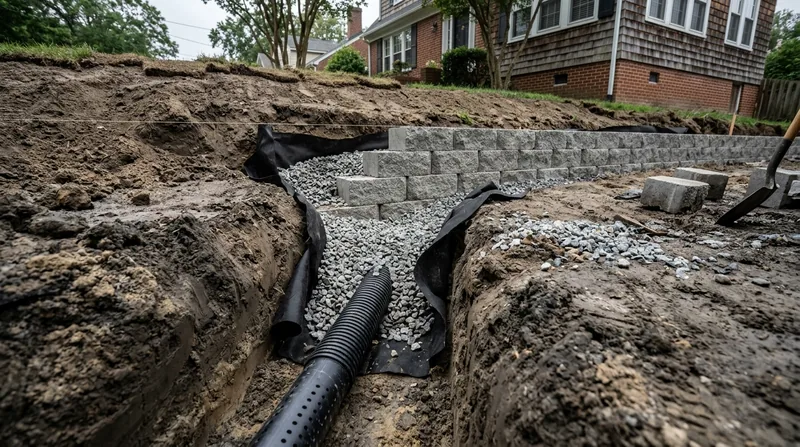




Norfolk sits on a low, flat coastal plain where the Elizabeth River meets Hampton Roads, and much of the city barely rises a few feet above sea level. Tidal creeks like the Lafayette River and Knitting Mill Creek lace through neighborhoods, and the water table sits high under sandy silty soils. That combination makes Retaining Wall Drainage in Norfolk the single most important detail in any wall build, repair, or replacement. When water cannot escape, hydrostatic pressure builds behind the wall, fine soil washes out through the joints, and the wall starts to lean, bulge, or crack. We install French drains, weep holes, gravel backfill, and filter fabric that relieve that pressure and keep the soil where it belongs. From the old brick garden walls of Freemason to the segmental block holding raised lots in Larchmont, drainage decides whether a wall lasts decades or fails in a few wet seasons. If your wall is already showing movement, start with leaning and collapsed wall repair before the problem gets worse.
Why Drainage Decides Whether a Norfolk Wall Survives the Next Nor'easter
Norfolk gets hit from both directions: storm downpours dump inches in hours, and tidal flooding pushes groundwater up from below during king tides and nor'easters. Sandy and silty coastal soils drain unevenly, and when water is trapped behind a wall, the pressure has nowhere to go but through the structure. Add subterranean termites working the wood in older timber and railroad tie walls, and the buried portions fail fast. The failure mode we see most here is backfill saturation combined with soil piping, where fine particles wash out through open joints and leave voids behind the wall.
- French drains collect groundwater at the footing and carry it away from the wall base.
- Weep holes release water that builds up in the backfill so it never pushes the wall outward.
- Gravel backfill creates a free-draining zone that reduces hydrostatic pressure on the wall face.
- Filter fabric keeps fine Norfolk silt from clogging the gravel and washing out of the wall.
- Surface grading and swales redirect downspout and yard runoff before it reaches the wall.
We size every drainage component to the wall height, soil type, and how much water the lot actually moves during a storm.
Key info: A low brick garden wall in Ghent that looks solid can be holding a saturated backfill with no weep holes at all. After one heavy summer downpour, that water finds the weakest mortar joint and the wall starts to bow. We have reopened blocked weep holes and added gravel backfill on walls like this for a fraction of what replacement would cost.
For official guidance on floodplain and stormwater rules that affect wall and drainage work, check the City of Norfolk website and confirm permit thresholds with the local building department before you dig.
How We Build Drainage That Works With Norfolk's Wet Coastal Ground
We start by reading the site, not by guessing. We look at where water enters the lot, how the wall is built, what the soil is doing, and where the outlet can safely discharge. On a waterfront lot in Edgewater or along the Lafayette River, the outlet has to account for high tide and backflow. Inland in Norview or Wards Corner, the concern is usually storm runoff from roofs and driveways. We build the drainage system around those realities, then backfill and compact in lifts so the wall and the drain work together.
- We walk the wall and the lot to identify water sources, low spots, and the existing wall construction.
- We expose the footing and check for voids, soil piping, and blocked or missing weep holes.
- We trench and install perforated pipe in a washed gravel envelope wrapped in filter fabric.
- We set weep holes at the correct spacing and height so water exits instead of pooling.
- We place clean gravel backfill against the wall and cap it with fabric and soil.
- We grade the surface and connect the outlet so discharge runs away from the wall and the house.
Every step is inspected before we backfill, because once the soil goes back in, the drain is only as good as the work underneath it.
Key info: On a raised lot in Larchmont, a segmental block wall was bulging after two seasons. The cause was a missing gravel envelope and no outlet, so the drain pipe dead-ended into soil. We rebuilt the drain with a proper outlet to the storm swale, added weep holes, and the wall has held straight since. A homeowner in Colonial Place had the same pattern after a nor'easter pushed groundwater up under a low waterfront wall.
If the wall has already failed, drainage is part of the rebuild, not an add-on. See how we handle retaining wall replacement when the structure cannot be saved.
Drainage Approaches We Use on Norfolk Walls
The right system depends on wall type, height, soil, and where the water can go. These are the approaches we use most on Norfolk properties, from historic brick walls to modern segmental block.
| Approach | Description | Best for |
|---|---|---|
| French drain at footing | Perforated pipe in gravel wrapped in filter fabric, with a graded outlet | Most walls with saturated backfill and no existing drain |
| Weep holes and gravel backfill | Spaced outlets through the wall face with clean gravel behind | Brick, block, and concrete walls that trap water |
| Filter fabric and soil separation | Fabric layer that stops fine silt from clogging the drain | Sandy and silty Norfolk soils prone to piping |
| Surface grading and swales | Regrading and shallow channels that move runoff away from the wall | Lots where roof and yard water reach the wall |
| Tidal and backflow-aware outlet | Outlet placed and protected so high water cannot push back into the drain | Waterfront walls along the Lafayette River and Ocean View |
We match the approach to the wall and the lot, and we tell you plainly when a simpler fix will do the job.
Retaining Wall Drainage Cost in Norfolk: What to Expect
Drainage work starts from $2,500 for a typical residential wall with a French drain, gravel backfill, filter fabric, and weep holes. That figure moves with wall length and height, how much excavation the site allows, soil conditions, and whether the outlet has to be run a long distance or protected from tidal backflow. A short wall in Norview with easy access sits near the starting point. A tall tiered wall in Riverview or a waterfront wall in Willoughby Spit with limited access and a high water table runs higher, because the excavation, gravel volume, and outlet work all increase.
We give you a written scope that separates the drain, the backfill, and the surface work so you can see what each part costs. Get two or three estimates and compare the scope line by line, not just the total, because a low number often leaves out the outlet or the filter fabric. For a broader look at how we price wall work, see our full pricing overview.
Retaining Wall Drainage Near Me: How to Choose a Contractor Near Norfolk
Drainage is invisible once the soil goes back, so the contractor's habits matter more than the sales pitch. Ask for proof of insurance, get at least two or three written estimates with a defined scope, and ask for references on walls similar to yours. Confirm who pulls the permit, because walls above roughly four feet, or walls that support a driveway or structure, often need one, and engineered drawings may be required for tall or tiered walls. Verify the current thresholds with the local building department before work starts. If your property is in a historic district or under HOA rules, check those requirements early so the drainage plan and the visible finishes both pass review.
Ask specifically how the contractor will handle the outlet and the filter fabric, because those two details decide whether the drain still works in five years. We are fully insured and hold NCMA Segmental Retaining Wall Installer Certification, and we will walk you through the plan before anyone digs. Reach out through our contact page to set up a free estimate at (757) 960-7978.
Retaining Wall Drainage in Norfolk: Pricing Guide
| Service | Price | Details |
|---|---|---|
| French drain and gravel backfill | Starting at $2,500 | Includes perforated pipe, washed gravel, filter fabric, and a graded outlet for a typical residential wall |
| Weep holes and drainage retrofit | Starting at $2,500 | Adds spaced weep holes and clean gravel behind an existing wall, price rises with wall length |
| Waterfront or high water table system | On estimate | Tidal backflow protection and deeper excavation need an on-site look before pricing |
| Travel | Included | in Norfolk and surrounding areas, no separate call-out or mileage fee |
| Estimate | Free | Response within 24h at (757) 960-7978, no obligation to book |
Indicative pricing, the exact cost depends on square footage, finish, and site access. Free personalized estimate within 24h at (757) 960-7978.


