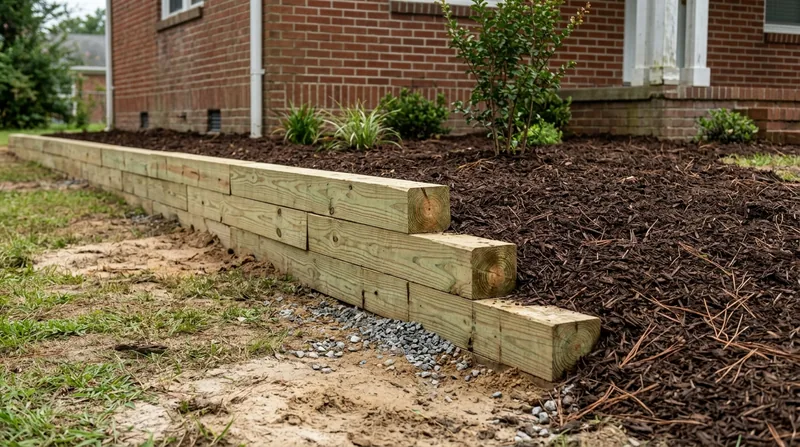




Timber Retaining Walls in Norfolk: Built for Garden Beds, Not for Tidal Floods
Norfolk sits on low, flat coastal plain where the Elizabeth River meets Hampton Roads, and much of the city is only a few feet above sea level. That means Timber Retaining Walls in Norfolk do a real job in backyards from Ghent to Larchmont, but they also face conditions that chew through wood faster than almost anywhere in Virginia. We install pressure-treated timber walls for garden beds, low terraces, and modest grade changes, and we tell you plainly when block is the smarter call. If your old tie wall is already leaning or rotting, start with our leaning and collapsed wall repair page before you spend a dollar on new lumber.
The honest math: coastal humidity, recurring tidal flooding, and subterranean termites all shorten timber's life here. A wall that lasts 20 years in the Piedmont may give you 10 to 12 in Ocean View or Colonial Place. We build timber walls that drain properly and sit on solid footings, and we tell you when a low timber wall is the right budget move and when it is a mistake.
Why Timber Walls Fail Faster in Norfolk Than Anywhere Inland
Norfolk's soils are sandy and silty over a high water table, and the city floods on king tides and nor'easters, not just on storm days. Wood that stays wet at the base rots from the bottom up, and the termite pressure under live oaks, crape myrtles, and loblolly pines is heavy. Add the fast relative sea-level rise along this stretch of the East Coast and you get walls that are asked to hold back saturated ground far more often than their inland cousins.
- Pressure-treated pine and landscape timbers soak up groundwater in low yards near the Lafayette River and Knitting Mill Creek.
- Subterranean termites tunnel into untreated or poorly drained timbers and hollow them out from the inside.
- Railroad tie walls from the 1970s and 1980s in Norview and Wards Corner are now creosote-leaching, leaning, and past saving.
- Tidal flooding pushes hydrostatic pressure against the back of the wall and bows timbers outward.
- Cheap 4x4 or 6x6 stacks without gravel backfill and drain tile fail within a few seasons.
If your wall is already bulging or the top course has shifted, the repair window is short, and we would rather look at it now than replace it later.
Key info: A timber wall in Larchmont that stays dry most of the year may last 15 years. The same wall in a low yard off Willoughby Spit that takes tidal water several times a month may last 8 to 10. We size the timber, the gravel, and the drainage to the actual water exposure, not to a generic spec sheet.
Before you commit to timber, check the permit threshold with the City of Norfolk building department, because walls above roughly 4 feet from the footing, or walls that support a driveway or structure, usually need a permit and sometimes engineered drawings.
How We Build a Timber Wall That Survives Norfolk Humidity
We do not stack timbers on bare dirt and call it a wall. Every timber wall we build starts with a compacted gravel footing trench, then a deadman or geogrid anchor system tied back into the slope, then a gravel backfill column wrapped in filter fabric, then a drain tile that daylight at the low end of the yard. That sequence is what keeps water from sitting against the wood and what keeps the wall from walking forward after the next nor'easter.
- We walk the site and check the grade, the water table, and where stormwater actually leaves the yard.
- We dig a footing trench and compact crushed stone to a level base, deeper on soft fill near the water.
- We set the first course perfectly level, because every course above it inherits that line.
- We install deadmen and geogrid to tie the wall back into the hillside, not just into itself.
- We backfill with washed gravel, wrap it in filter fabric, and run perforated drain tile to a daylight point.
- We cap the wall and check the finished grade so water sheds away from the timber, not into it.
On a recent job in Colonial Place, we replaced a rotted 3-foot tie wall holding a raised backyard with a pressure-treated timber wall on a gravel footing with a full drain tile run to the street. The homeowner had watched it bow for two seasons after heavy rain, and the new wall has stayed plumb through two king tides.
Key info: If your yard sits within a few blocks of the Lafayette River or a tidal creek, ask us to check the drainage before we quote timber. In those yards, a proper retaining wall drainage system matters more than the wall material itself.
Timber Wall Approaches We Use in Norfolk Yards
Not every Norfolk yard wants the same wall. A garden bed in Ghent, a low terrace in Edgewater, and a shoreline lawn above a bulkhead each need a different build. Here is how we match the approach to the site.
| Approach | Description | Best for |
|---|---|---|
| Low garden bed wall (under 18 inches) | Single or double course of pressure-treated 4x4 or 6x6 on a gravel footing, no engineering required. | Raised planting beds in Ghent and Larchmont backyards. |
| Terraced timber wall (18 inches to 3 feet) | Stacked 6x6 timbers with deadmen, gravel backfill, and drain tile behind the wall. | Grade changes in Colonial Place and Riverview lots. |
| Timber wall with geogrid reinforcement | Geogrid layers tie the wall back into the slope for taller or surcharge-loaded walls. | Walls near driveways, patios, or structures where the top of the wall carries weight. |
| Timber replacement for old railroad ties | Pull the creosote ties, dispose of them legally, and rebuild in pressure-treated timber or block. | Aging tie walls in Norview, Wards Corner, and Ocean View. |
| Timber to block upgrade | We tell you when timber is the wrong call and quote a segmental block wall instead. | Waterfront lawns and flood-prone yards where timber will not last. |
We will tell you which row your yard falls into after a site visit, and we will not sell you a timber wall where a block wall is the honest answer.
Timber Retaining Walls Cost in Norfolk: What to Expect
Timber is the budget-friendly option, and most low garden walls in Norfolk start around From $20 per square foot of wall face. That figure covers pressure-treated lumber, gravel footing, filter fabric, drain tile, and labor. It moves up when the wall is taller than 3 feet, when access is tight behind a Ghent townhouse, when old railroad ties have to be pulled and disposed of, or when the yard floods and needs a heavier drainage build.
Two things drive the price more than anything else in this city: how wet the yard gets and how close the wall sits to a structure. A wall holding a raised driveway pad in Larchmont costs more than a garden bed wall in the same block because the loads and the permit requirements are different. Get two or three estimates, ask each contractor what they are doing for drainage, and compare the drainage scope line by line, not just the total.
Our full pricing overview breaks down the ranges by wall type and height so you can sanity-check any quote you receive.
Hiring a Retaining Wall Contractor Near Me in Norfolk: What to Check
You are about to let someone dig up your yard and stack weight against your house, so check the basics before you sign. Ask for proof of insurance, ask for references from Norfolk jobs within the last year, and ask who pulls the permit if your wall crosses the roughly 4-foot threshold or supports a driveway. A contractor who cannot answer those three questions clearly is not the one you want.
- Confirm the company carries liability and workers' compensation coverage, and ask for a certificate before work starts.
- Get two or three written estimates that itemize drainage, footing, and disposal, not one lump sum.
- Ask for local references in Norfolk, Virginia Beach, or Chesapeake and actually call one.
- Check with the City of Norfolk building department on permit thresholds and setback rules before work begins.
- If your home sits in a historic district like Freemason or Ghent, ask about design review requirements before you buy materials.
We are fully insured, and we will send you a certificate on request. Reach out through our contact page and we will set up a free estimate at your property.
One more local note: if your old wall is already leaning, do not wait for the next nor'easter to finish it off. Call (757) 960-7978 and we will tell you whether it can be repaired or needs to come out.
Timber Retaining Walls in Norfolk: Pricing Guide
| Service | Price | Details |
|---|---|---|
| Low garden bed timber wall (under 18 inches) | Starting at $20/sq ft | Includes pressure-treated lumber, gravel footing, filter fabric, and labor for low planting bed walls. |
| Terraced timber wall (18 inches to 3 feet) | Starting at $32/sq ft | Adds deadmen, gravel backfill, and drain tile for grade changes behind the wall. |
| Timber wall with geogrid reinforcement | Starting at $45/sq ft | Geogrid layers tie the wall back into the slope where the top carries a surcharge load. |
| Railroad tie removal and timber rebuild | On estimate | Creosote tie disposal, footing rebuild, and new pressure-treated wall priced after an on-site look. |
| Travel | Included | In Norfolk and surrounding Hampton Roads cities, no separate call-out or mileage fee. |
| Estimate | Free | Response within 24 hours at (757) 960-7978, no obligation to book the job. |
Indicative pricing, the exact cost depends on square footage, finish, and site access. Free personalized estimate within 24h at (757) 960-7978.


