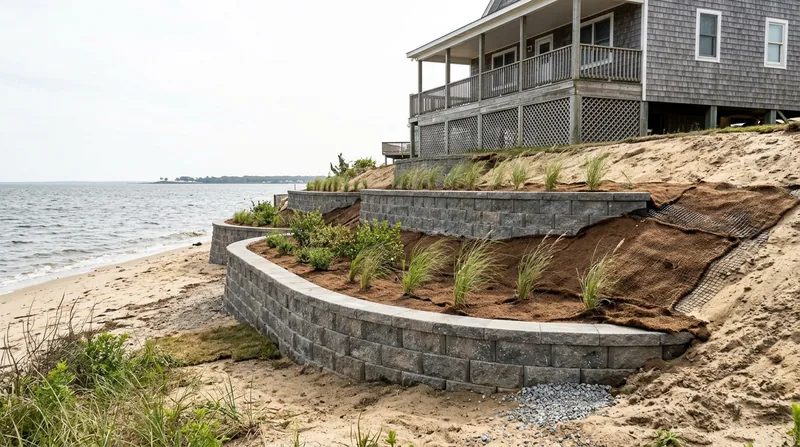




Slope Stabilization & Erosion Control in Norfolk: Holding the Line on Low, Wet Ground
Norfolk sits on a low coastal plain where the Elizabeth River meets Hampton Roads, and much of the city barely clears sea level. Tidal creeks like the Lafayette River and Knitting Mill Creek cut through neighborhoods from Ghent to Edgewater, and the land itself is slowly subsiding. That combination makes Slope Stabilization & Erosion Control in Norfolk a practical necessity, not a landscaping luxury. Sandy and silty soils over a high water table lose their grip fast, and a nor'easter or a king tide can strip a creek bank in a single night. We build terraced walls, geogrid-reinforced slopes, and erosion control systems that protect raised lots, waterfront lawns, and home pads from Ocean View to Larchmont. If you are already seeing movement, start with retaining wall repair before the slope gives way entirely.
Why Slope Stabilization Matters on Norfolk's Tidal Creeks and Raised Lots
Most Norfolk slope failures start with water, not gravity. The soil here is sandy and silty, the water table sits high, and tidal creeks rise and fall twice a day against banks that were graded decades ago. Add subterranean termites working under live oaks and loblolly pines, and you get root systems that rot out and leave nothing holding the soil. When a bank lets go along the Lafayette River or behind a raised pad in Norview, the damage reaches the house fast.
- Recurrent tidal flooding and king tides saturate the soil and drop its shear strength.
- Nor'easters and hurricanes like Isabel in 2003 strip vegetation and undercut creek banks in hours.
- Humid summer downpours overload undersized drainage and push saturated soil downhill.
- Rotting timber and railroad tie walls in older backyards stop retaining anything and become the slide.
- Termites and root decay hollow out the organic matter that once held the slope together.
We grade, drain, and reinforce the slope so it sheds water instead of absorbing it, and we tie the work into a wall system that can take a surcharge.
Key info: A bank behind a home in Colonial Place lost about four feet of face after a nor'easter pushed the Lafayette River over its bulkhead. We rebuilt it with terraced segmental block and geogrid, and the homeowner avoided a foundation repair that would have cost far more than the stabilization.
For the official rules on grading and floodplain work, check the City of Norfolk's permits page at norfolk.gov before any bank work begins.
How We Stabilize a Norfolk Slope, Step by Step
Every slope we take on gets the same first treatment: we find where the water is coming from and where it needs to go. On the raised lots and creek banks around here, that means reading the tide, the soil, and the grade before we set a single block. We hold NCMA Segmental Retaining Wall Installer Certification, and we build to that standard on every reinforced slope.
- We walk the site and map the drainage, including tidal influence and the high water table.
- We test the soil and check for termite activity and root decay under the existing trees.
- We design the wall or terrace with geogrid layers set at the depth the load requires.
- We excavate, install drainage aggregate and outlet piping, and compact in lifts.
- We build the wall or boulder face, then seed or armor the exposed slope above it.
- We verify the outlet actually discharges and leave you with a maintenance plan.
The result is a slope that drains, holds, and does not depend on a rotting timber wall to stay put. If your existing wall is already leaning, see our leaning and collapsed wall repair page for the emergency path.
Key info: On a Willoughby Spit beach cottage lot, the grade had been built up over an old timber wall that was rotting at the base. We replaced the timber with a geogrid-reinforced block terrace and reset the drainage so storm surge drains off the pad instead of pooling behind the house.
Stabilization and Erosion Control Methods We Use in Norfolk
The right approach depends on the slope height, the soil, the water, and what sits above it. A waterfront lawn above a bulkhead in Edgewater needs a different system than a raised driveway pad in Wards Corner. We match the method to the load and the drainage, not to a catalog.
| Approach | Description | Best for |
|---|---|---|
| Terraced segmental block with geogrid | Layered block walls stepped up the slope, tied back with geogrid reinforcement. | Creek banks and raised lots along the Lafayette River. |
| Boulder and riprap toe protection | Natural stone placed at the toe to absorb wave and current energy. | Waterfront lawns and tidal edges above bulkheads. |
| Drainage and dewatering systems | Aggregate, filter fabric, and outlet piping that move water off the slope. | Saturated slopes with a high water table. |
| Slope regrading and vegetative armor | Reshaping the bank and seeding or armoring the face to stop surface erosion. | Low banks and yards with shallow surface wash. |
| Poured concrete retaining structure | Cast-in-place walls for heavy loads and tight property lines. | Driveway pads and structural surcharges. |
Each of these systems depends on drainage that works, which is why we treat retaining wall drainage as part of the structure, not an add-on.
Slope Stabilization & Erosion Control Cost in Norfolk: What to Expect
Every job starts with a free estimate, and that is the only honest starting point for a slope. The price depends on how much soil is moving, how deep the failure goes, and how close the work sits to the house. A short bank behind a Larchmont bungalow is a different job from a waterfront lawn in Ocean View that needs boulder toe protection and a new terrace.
Expect the cost to move with slope height and length, access for equipment, the wall system you choose, and how much drainage has to be rebuilt. Tidal exposure, termite damage, and proximity to structures all add work. Get two or three estimates and compare scope, not just the bottom line, because a cheap number that skips the drainage will fail in the next nor'easter. Our pricing overview breaks down how we build a number.
What to Look for When Hiring a Retaining Wall Contractor Near Norfolk
Hiring for slope work near Norfolk means asking harder questions than you would for a patio. The contractor needs to understand tidal water, high water tables, and the permit thresholds that apply to walls above roughly four feet or walls that carry a driveway or structure. Ask for proof of insurance, references on similar creek-bank or raised-lot jobs, and a written scope that names the drainage.
Check whether engineered drawings are required for your wall height or tier, and confirm setback and property-line rules with the city building department. If your lot sits in a historic district like Freemason or Ghent, expect design review on top of the building permit. HOA rules can add another layer on waterfront lots. We are fully insured and can provide a certificate on request. Reach out through our contact page to set up a site visit.
Slope Stabilization & Erosion Control in Norfolk: Pricing Guide
| Service | Price | Details |
|---|---|---|
| Slope stabilization site assessment | Free estimate | On-site drainage and soil review, written scope, and a firm number before any work starts. |
| Erosion control and drainage retrofit | Starting at $2,800 | Aggregate, filter fabric, and outlet piping sized to the slope and the water table. |
| Terraced segmental block with geogrid | Starting at $6,500 | Reinforced block terrace for creek banks and raised lots, priced by height and length. |
| Boulder and riprap toe protection | On estimate | Stone size and tonnage depend on tidal exposure and how much bank has already been lost. |
| Travel | Included | In Norfolk and surrounding areas, no separate call-out or mileage fee. |
| Estimate | Free | Response within 24h at (757) 960-7978, no obligation to book. |
Indicative pricing, the exact cost depends on square footage, finish, and site access. Free personalized estimate within 24h at (757) 960-7978.


