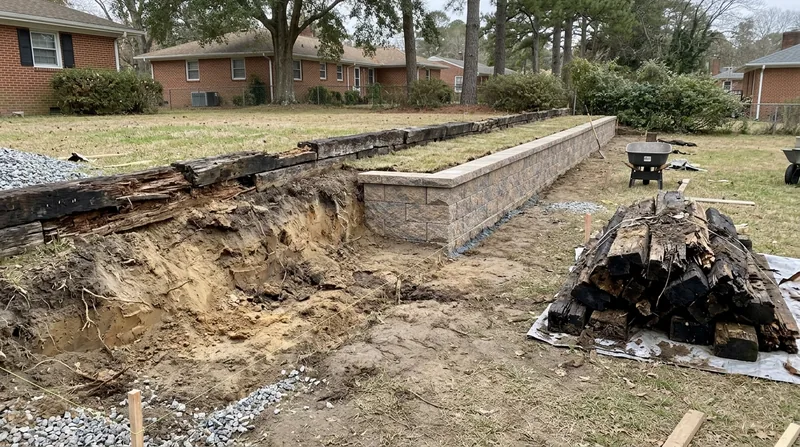




Railroad Tie Wall Replacement in Norfolk: When the Old Ties Have to Go
Norfolk sits on a low, flat coastal plain where the Elizabeth River meets Hampton Roads, and a lot of that ground is only a few feet above sea level. The railroad tie walls that went in across Ghent, Colonial Place, Larchmont, and Norview back in the 1980s and 90s are now pushing forty years old, and most of them are done. If you are searching for Railroad Tie Wall Replacement in Norfolk, you already know the score: the ties are cracked, the wall is leaning, and the soil behind it is washing out. We tear out the old creosote ties, haul them away, fix the drainage, and rebuild the wall in block, concrete, or brick. Creosote-soaked timber does not belong in a modern Norfolk yard, and it does not hold up to our water table either. Start with our retaining wall replacement service to see how a rebuild works.
Why Railroad Tie Walls Fail Faster in Norfolk Than Anywhere Else
Treated timber rots from the inside out, and Norfolk gives it every advantage. The water table sits high, tidal creeks like the Lafayette River and Knitting Mill Creek push water into backyards on king tides, and summer downpours soak the soil for days. Add subterranean termites working under the live oaks and crape myrtles, and a tie wall has a short life here. The dominant failure mode is simple: the ties rot at the soil line, the wall bows, and the top courses lean into the yard.
- Creosote ties crack and split along the grain after repeated wet and dry cycles.
- Termites tunnel through soft wood at the base and hollow out the wall from below.
- Poor or missing gravel backfill lets silt clog the drainage path and hydrostatic pressure builds.
- Nor'easters and hurricane remnants like Isabel in 2003 push water against walls that are already weak.
- Old ties were often set with no filter fabric, so fine sandy soil migrates into the gravel and blocks it.
Once the ties are soft and the wall is leaning, patching it is wasted money. A full replacement is the only fix that lasts.
Key info: A 1990s tie wall on a Riverview lot above the Lafayette River often shows rot two or three courses down while the top still looks solid. We probe the base before quoting, because what you see up top is rarely the whole story.
If you want to check what your city requires before work starts, the City of Norfolk planning and permits pages are the place to confirm wall height thresholds and setback rules.
How We Replace a Railroad Tie Wall in Norfolk, Step by Step
Every tie wall replacement starts with a site read, not a demo hammer. We look at the slope, the soil, the water table, and what sits above the wall (a driveway, a patio, a raised home pad). Then we build the sequence around your property so nothing on the uphill side collapses during the tear-out.
- We mark utilities and confirm the wall line, setback, and any permit threshold with the city.
- We remove the old ties course by course and separate the creosote timber for proper haul-away.
- We excavate to a stable base and compact a crushed stone footing below frost and flood level.
- We set filter fabric and clean gravel backfill so water drains instead of pressing on the wall.
- We install a perforated drain pipe at the base and daylight it away from the wall.
- We build the new wall in block, poured concrete, or brick, compacting lifts as we go.
- We cap the wall, backfill, and restore the grade and lawn above it.
The result is a wall that sheds water instead of holding it, which is the whole game in Norfolk's sandy, silty soil.
Key info: On a Larchmont bungalow lot, we pulled a 32-foot tie wall that had bowed six inches into a side yard. The rebuild used segmental block on a gravel footing with a drain pipe run to the street, and the yard has stayed dry through two nor'easters since.
Drainage is not an add-on here. Read our retaining wall drainage service to see why the backfill matters as much as the block.
Rebuild Options: What Replaces the Old Ties
You have real choices when the ties come out, and the right one depends on height, load, and how the wall looks against the house. In Norfolk's historic districts a brick or block wall reads better against a Federal or Victorian facade, while a modern raised pad in Ocean View can take a clean segmental block face without a second look.
| Approach | Description | Best for |
|---|---|---|
| Segmental block rebuild | Interlocking block on compacted gravel footing with filter fabric and drain pipe. | Most residential tie walls, 2 to 5 feet tall. |
| Poured concrete rebuild | Formed and poured wall with rebar, engineered for load and surcharge. | Walls holding a driveway or structure above. |
| Brick garden wall rebuild | Masonry face matched to the house, with a proper footing and weep drainage. | Freemason and Ghent historic properties. |
| Tiered or stepped rebuild | Two shorter walls with a planted bench between them to cut load and height. | Steep yards above tidal creeks. |
We match the rebuild to the load and the house, not to a catalog photo. If your wall needs more than a like-for-like swap, we tell you before the first tie comes out.
Railroad Tie Wall Replacement Cost in Norfolk: What to Expect
Most tie wall replacements in Norfolk start around From $35/sq ft of wall face, and that figure covers demolition, creosote haul-away, new gravel backfill, drainage, and a block rebuild. Price climbs with height, with how hard it is to get a machine or a wheelbarrow to the wall, and with what sits above it. A wall holding up a driveway costs more than one holding a flower bed, because the engineering and the footing change.
- Wall height and length drive the square footage and the footing depth.
- Access matters: a Ghent side yard behind a fence is slower than an open Ocean View lot.
- Creosote haul-away adds cost because treated timber needs proper disposal.
- Surcharge loads (driveways, patios, structures) push you toward concrete and engineering.
- Hidden rot and failed footings show up after demo and can change the scope.
Get two or three written estimates on the same scope, and make sure each one spells out drainage and haul-away. Cheap quotes usually skip the gravel and the pipe, and you pay for that later.
Our full pricing overview breaks down the ranges by wall type and size.
Railroad Tie Wall Replacement Near Me: What Norfolk Homeowners Should Check Before Hiring
Picking a contractor for a tie wall replacement near Norfolk comes down to a few plain checks, and none of them are hard to do. Ask for proof of insurance, ask for recent local jobs you can look at, and ask how the company handles the creosote timber. A crew that cannot answer the drainage question clearly is not the crew for a wall that has to survive a king tide.
- Confirm the company carries liability and workers compensation coverage and ask for a certificate.
- Get multiple written estimates with the same scope so you compare apples to apples.
- Ask for references on tie wall replacements done in the last two years in Norfolk or Chesapeake.
- Check whether your wall needs a city permit based on height and surcharge, and who pulls it.
- Ask about HOA rules if you live in a planned community, and about historic district review in Freemason or Ghent.
We are fully insured and hold NCMA Segmental Retaining Wall Installer Certification, and we will walk you through every one of these points before you sign anything. Reach out through our contact page to set up a free estimate.
Railroad Tie Wall Replacement in Norfolk: Pricing Guide
| Service | Price | Details |
|---|---|---|
| Standard tie wall replacement (block) | Starting at $35/sq ft | Includes creosote tie demolition, haul-away, gravel backfill, drain pipe, and block rebuild. |
| Concrete rebuild with surcharge load | Starting at $55/sq ft | Formed and reinforced wall for driveways or structures above, includes engineered footing. |
| Brick garden wall rebuild | Starting at $60/sq ft | Masonry face matched to historic homes, includes weep drainage and matched cap. |
| Complex or large-scale job | On estimate | Tiered walls, tight access, or hidden rot found at demo need an on-site look. |
| Travel | Included | In Norfolk and surrounding areas, no separate call-out or mileage fee. |
| Estimate | Free | Response within 24h at (757) 960-7978, no obligation to book. |
Indicative pricing, the exact cost depends on square footage, finish, and site access. Free personalized estimate within 24h at (757) 960-7978.


