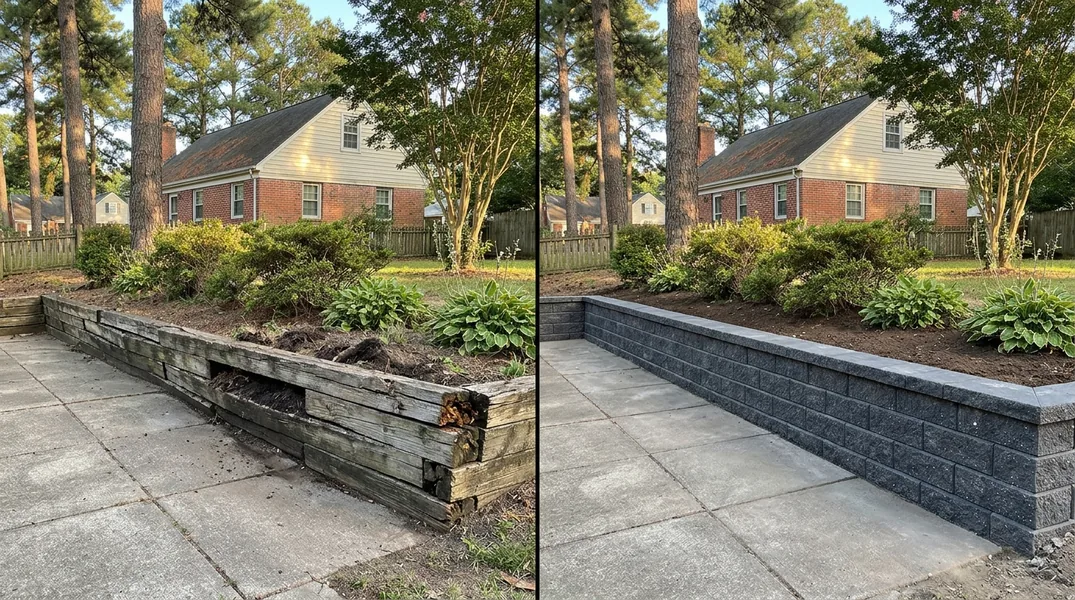
Why Norfolk's Nor'easters and King Tides Are Hard on Retaining Walls
If you own property in Norfolk, you already know that water is a fact of life. Between nor'easters that push Atlantic moisture inland and king tides that send the Elizabeth River and Chesapeake Bay over bulkheads and into yards, the soil behind your retaining wall can go from dry to saturated in a matter of hours. That cycle repeats several times a year, and it is the single biggest reason retaining walls fail in this region.
What most homeowners do not realize is that the wall itself is rarely the weak point. The real vulnerability is the drainage system behind it. When water cannot escape, it builds up in the backfill and pushes against the wall with enormous force. Engineers call this hydrostatic pressure, and it is the quiet killer of retaining walls across Hampton Roads. A wall that looks perfectly fine in July can be leaning or cracked by March, not because the blocks or concrete were bad, but because the water behind it had nowhere to go.
Understanding how that pressure works, and what a proper retaining wall drainage system looks like, is the difference between a wall that lasts decades and one that needs expensive intervention after the first big storm.
How Hydrostatic Pressure Builds Behind a Retaining Wall
Soil is not a solid block. It is a mixture of particles with void spaces between them, and those voids fill with water during heavy rain or tidal flooding. When the ground behind a wall becomes saturated, the water table rises and the weight of that water creates hydrostatic pressure retaining wall engineers design against. The deeper the water, the greater the pressure at the base of the wall. In a storm surge scenario, that pressure can double or triple in a single tide cycle.
Most retaining walls are designed to hold back soil, not standing water. When hydrostatic pressure exceeds what the wall was built for, several things happen at once. The wall begins to tilt forward at the top. Horizontal cracks appear along the mortar joints or block courses. The base can shift outward as the soil beneath it loses bearing capacity. In severe cases, the entire wall can bulge and collapse, especially if the backfill is heavy clay that holds moisture rather than draining it.
Norfolk's soils make this worse. Much of the area sits on clay and silt that drains slowly, so water lingers behind walls long after the storm has passed. A wall that survived the nor'easter itself may fail days later as the saturated backfill keeps pushing. This delayed failure is common and often catches homeowners off guard.
The Role of a Retaining Wall French Drain (and What Happens When It Fails)
The standard defense against hydrostatic pressure is a retaining wall french drain: a perforated pipe wrapped in filter fabric and set in gravel at the base of the wall, designed to collect groundwater and carry it away before pressure builds. Behind the pipe, a layer of clean gravel allows water to flow freely to the drain, and weep holes through the wall give any remaining water an exit path. When this system works, the soil behind the wall stays drained and the wall only carries the load it was designed for.
When it fails, the consequences are predictable. Filter fabric clogs with fine silt over time, especially in clay-heavy soil. Gravel gets fouled. Weep holes get blocked by roots, debris, or poor installation. The perforated pipe can be crushed during backfilling or laid at the wrong slope, so water sits in it instead of flowing out. Once any of these happen, the drain stops functioning and the wall is suddenly carrying hydrostatic pressure it was never meant to handle.
Many older walls in Norfolk were built without any drainage at all, or with a single weep hole and a bit of gravel that has long since clogged. If your wall is more than 15 or 20 years old and you have never had the drainage inspected, there is a good chance it is already compromised. A professional assessment can tell you whether the system is still working or whether it is time for Retaining Wall Repair before the next storm season.
Warning Signs Your Wall's Drainage Is Already Failing
Drainage failure rarely announces itself with a collapse. It gives warning signs first, and homeowners who recognize them can act before the damage gets expensive. The most common sign is water pooling at the base of the wall or in the yard behind it after rain, which means the drain is not moving water away. You may also see muddy water seeping through weep holes or joints, which indicates fine soil is being washed out of the backfill.
Structural symptoms come next. Look for a wall that leans forward slightly when viewed from the end, horizontal cracks in block or concrete, or a bulge in the middle of the wall. Settling at the base, gaps between the wall and the soil behind it, or a noticeable tilt in a fence or gate mounted near the wall are also red flags. In Virginia Beach and Chesapeake, the same conditions show up after tidal flooding, and the fix is the same: restore drainage before the wall fails completely.
If you see any of these signs, do not wait for the next nor'easter. A wall that is still standing but showing symptoms can often be repaired with a new drain system and targeted structural work. A wall that has already shifted significantly may need Retaining Wall Replacement. Either way, an inspection is far cheaper than an emergency rebuild.
Retaining Wall Drainage Solutions That Hold Up in Coastal Virginia
Fixing drainage is not just a matter of clearing weep holes. A proper retrofit involves excavating behind the wall, removing failed filter fabric and clogged gravel, and installing a new perforated drain pipe at the correct slope with clean washed stone and fresh filter fabric. Weep holes are cleared or added, and the backfill is graded so water flows toward the drain rather than sitting against the wall. In low-lying areas, the drain may need to tie into a sump or discharge point that stays above the tidal water level.
For new construction, the best defense is to build drainage in from the start. That means designing the wall for the actual soil and water conditions on the site, using free-draining backfill, and installing a french drain with proper outlet. For walls that face constant tidal exposure, Concrete Retaining Walls with engineered reinforcement and robust drainage details often outperform segmental block walls over the long term. The right choice depends on your site, but the drainage principle is always the same.
If you are researching retaining wall drainage near me and want a straight answer about your own wall, the best first step is an on-site evaluation. Norfolk Retaining Wall serves homeowners across the region, and we can tell you whether your wall needs a drainage retrofit, a repair, or a full replacement. Call (757) 960-7978 or request a free estimate to get started.
Protecting Your Investment Before the Next Storm Season
Retaining wall drainage is one of those things that is invisible when it works and catastrophic when it does not. The homeowners who avoid five-figure wall failures are the ones who treat drainage as part of the wall, not an afterthought. A simple annual check before hurricane season, clearing weep holes, inspecting for pooling water, and watching for early tilting, can catch problems while they are still inexpensive to fix. After a major nor'easter or king tide, a quick walk-around is worth the ten minutes.
If your wall is older, was built without permits or engineering, or has already shown any of the warning signs above, schedule a professional inspection. Norfolk Retaining Wall can assess the drainage, identify what is failing, and recommend the most cost-effective path forward, whether that is a targeted drain retrofit or a larger repair. For questions about scope and pricing, call (757) 960-7978. Protecting your wall now is far cheaper than rebuilding it after the water wins.
Looking for a professional retaining wall contractor in Norfolk? Norfolk Retaining Wall responds fast for all your retaining wall needs.
Get a Free QuoteOur services: Retaining Wall Installation · Retaining Wall Repair · Retaining Wall Replacement